By Amy C. Walker
I. Where Zoning Comes From
You just bought a piece of property here in the United States and the State of Utah. You have big dreams about what you can do with that property. What’s the next step?
At common law, a landowner’s baseline right is to use property freely, and both constitutions protect property as a fundamental interest. The Utah Constitution guarantees the inherent and inalienable right “to acquire, possess and protect property.” Utah Const. art. I, § 1. It also provides that private property may not be taken or damaged for public use without just compensation. Utah Const. art. I, § 22. The federal counterparts are the Takings Clause of the Fifth Amendment and the Due Process Clause of the Fourteenth Amendment. U.S. Const. amend. V; U.S. Const. amend. XIV, § 1.
But neither constitution guarantees unrestricted use. Your right to use your property is subject to the laws that govern your property. So which laws are those?
Well, that depends on your zoning. Zoning authority comes from the state. Local governments can only regulate land use to the extent the State Legislature and federal government have authorized them to. Zoning survived its constitutional test in Village of Euclid v. Ambler Realty Co., 272 U.S. 365 (1926), where the U.S. Supreme Court upheld comprehensive zoning against a due process challenge. But Euclid did not create zoning authority.
In Utah, zoning authorization comes from LUDMA, which is shorthand for both the County Land Use, Development, and Management Act, Utah Code Title 17, Chapter 79, and the Municipal Land Use, Development, and Management Act, Utah Code Title 10, Chapter 20. LUDMA balances the right of property owners to develop their own property against the right of counties, cities, and towns to govern how their jurisdictions develop through zoning law.
II. What Your Zoning Allows
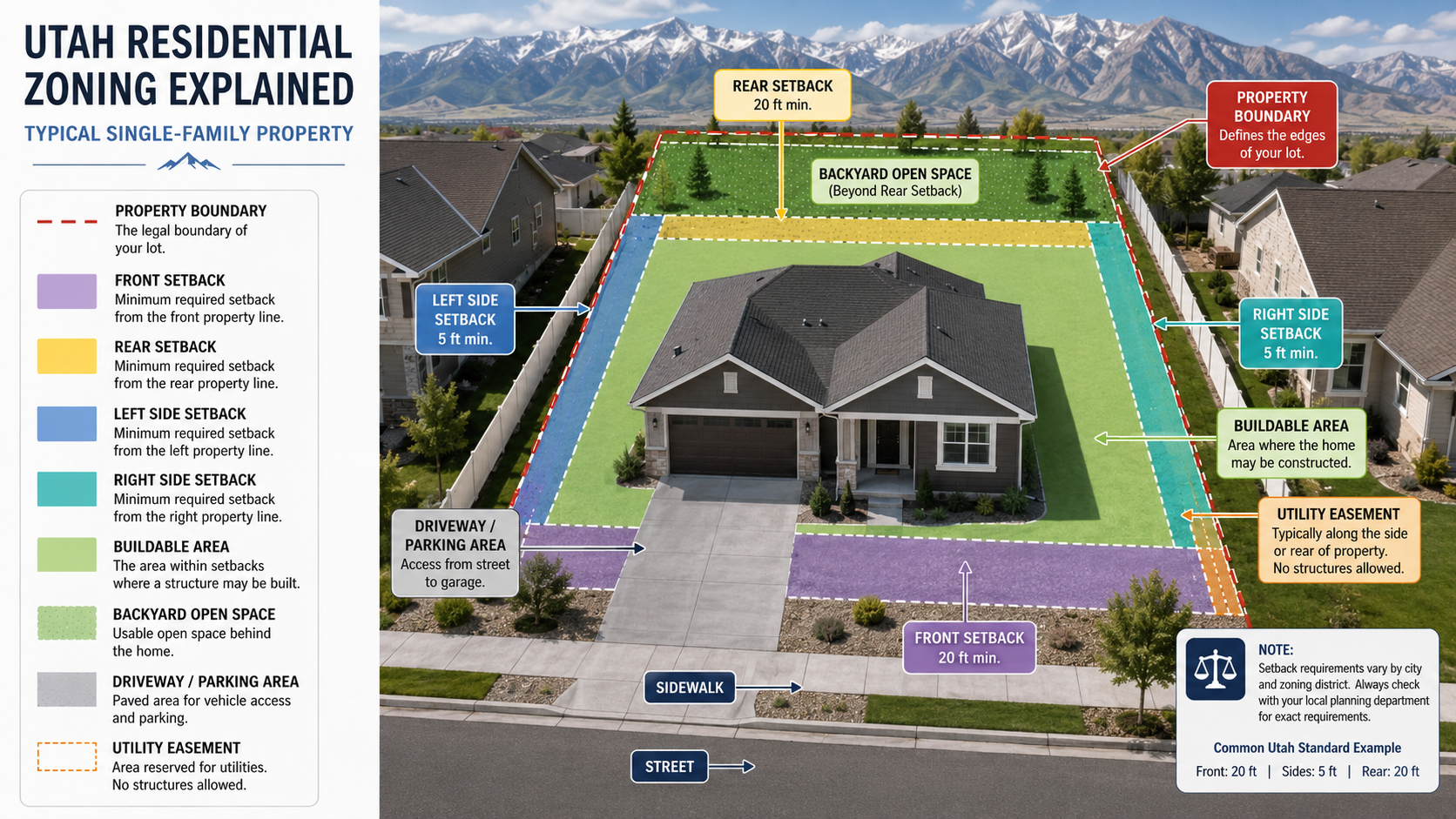
Your local governing body is the legislative body that sets the zoning for its jurisdiction through zoning ordinances. Zoning ordinances include the map or maps that show which zone your property is in, as well as the rules that say what is allowed in your zone. Typically, these will specify permitted uses, conditional uses, housing types, lot sizes and density, setbacks, open space requirements, and anything else your local government’s representatives think makes sense for the people who live there.
So, what can you do with your land? Whatever the zoning ordinances allow. And here LUDMA puts a thumb on the scale in your favor. A land use authority must apply the plain language of its land use regulations, and if a regulation does not plainly restrict a land use application, the authority must interpret and apply it to favor the application. Utah Code § 10-20-901(2); Utah Code § 17-79-801(2). Utah courts say the same thing: because zoning ordinances are in derogation of a property owner’s common-law right to unrestricted use, provisions restricting property uses are strictly construed in favor of the property owner. Patterson v. Utah County Bd. of Adjustment, 893 P.2d 602, 606 (Utah Ct. App. 1995).
If the ordinances look good, then before you build you’ll typically need a land use application and a building permit. And in some cases, subdivision or plat approval. Subdivisions are needed if you want to divide your property into more than one parcel or if your project otherwise requires it. And an applicant whose application conforms to the ordinance in effect at the time of submission is generally entitled to approval. Western Land Equities, Inc. v. City of Logan, 617 P.2d 388 (Utah 1980).
If you aren’t sure, most cities allow an initial review meeting on your project with the zoning administrator or community development director. They can point you in the right direction and often give you insight into the kinds of projects your local government likes and doesn’t like.
Applications also differ in how much discretion the local government has. Some are administrative approvals, which means that as long as you cross your t’s and dot your i’s, you’re entitled to approval. Others are discretionary, which is where the land use authority has room for a judgment call. A conditional use is the classic example. It’s a use that is allowed, but only if you can meet the conditions your local government imposes. Those conditions must be tied to codified standards, but they often include consistency with the general plan, demonstrating that you won’t harm your neighbors, and showing that traffic concerns can be mitigated. Importantly, a conditional use must be approved if the reasonably anticipated detrimental effects can be substantially mitigated. Utah Code § 10-20-506.
Legislative solutions can include asking for a rezone, requesting changes to the code, or entering into a development agreement. However, these are the hardest, as your only real legally protected right in the legislative process is at the ballot box through voting in your officials and, in some cases, referendum. Your local government can simply decline to change the code. And when it does change the code, it can do so for almost any reason, so long as the ordinance is constitutional, does not conflict with state law, and it is reasonably debatable that the ordinance serves a legitimate public purpose. Once your local representatives have enacted a lawful ordinance, it remains in effect until they decide to change it.
III. Getting Help
Land use approvals are complicated in practice. Which category your application falls into, what the ordinance actually says, and how quickly you have to act if something goes wrong vary from place to place. If you’re running into issues with your local governing body, or you’d like help getting your project approved, our office can help.
This post is general information, not legal advice. Amy Walker is an attorney at Miller Harrison Law in Murray, Utah, practicing land use, real estate development, and civil litigation. She holds a Masters in Real Estate Development in addition to her law degree and represents developers, municipalities, HOAs, and property owners throughout the entitlement process.